
A Walk in the Vale: Five Miles of Light walk, and Minor Domestics
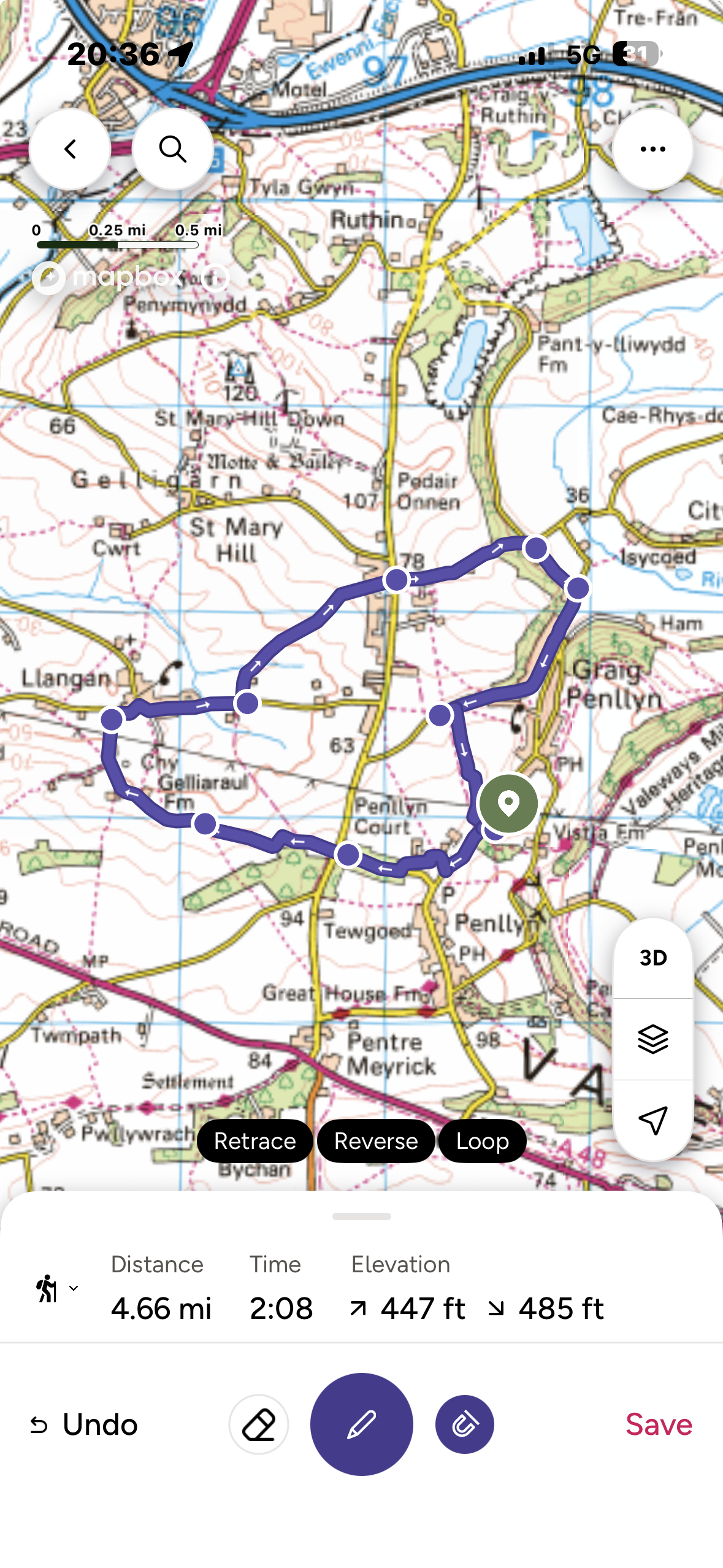
The afternoon didn’t promise much beyond a clean break in the drizzle, which, by the middle of May in Wales, is usually more than enough of an excuse to pull on the thick socks and find the boots. We had no grand ambitions for the day—no summits to tick off, no dramatic coastal paths to navigate, and certainly no desire to chase that aggressive, high-contrast light that seems to make people on the internet go entirely feral.
When you’ve lived a full, proper life before the world decided every single outing needed a digital receipt, you learn to value a very different kind of excursion. Jayne and I have a quiet, long-standing treaty when it comes to these walks: the camera comes along, but it lives over my shoulder, not glued to my face. We walk at the pace of two people who are thoroughly amused by the world but have absolutely nothing to prove to it. If the light catches a ridge, I’ll stop, frame it quickly, hear the mechanical click of the shutter, and then double my pace to catch up with Jayne and the dog.
Our route was a modest, five-mile loop cutting through the rolling farmland between Graig Penllyn and Llangan. Looking back at the contact sheet from that afternoon, the story of the walk unfolds with a beautiful, unforced logic, tracking the precise sequence of our footsteps from left to right across the top row of the film
The Wide Yellow Margin
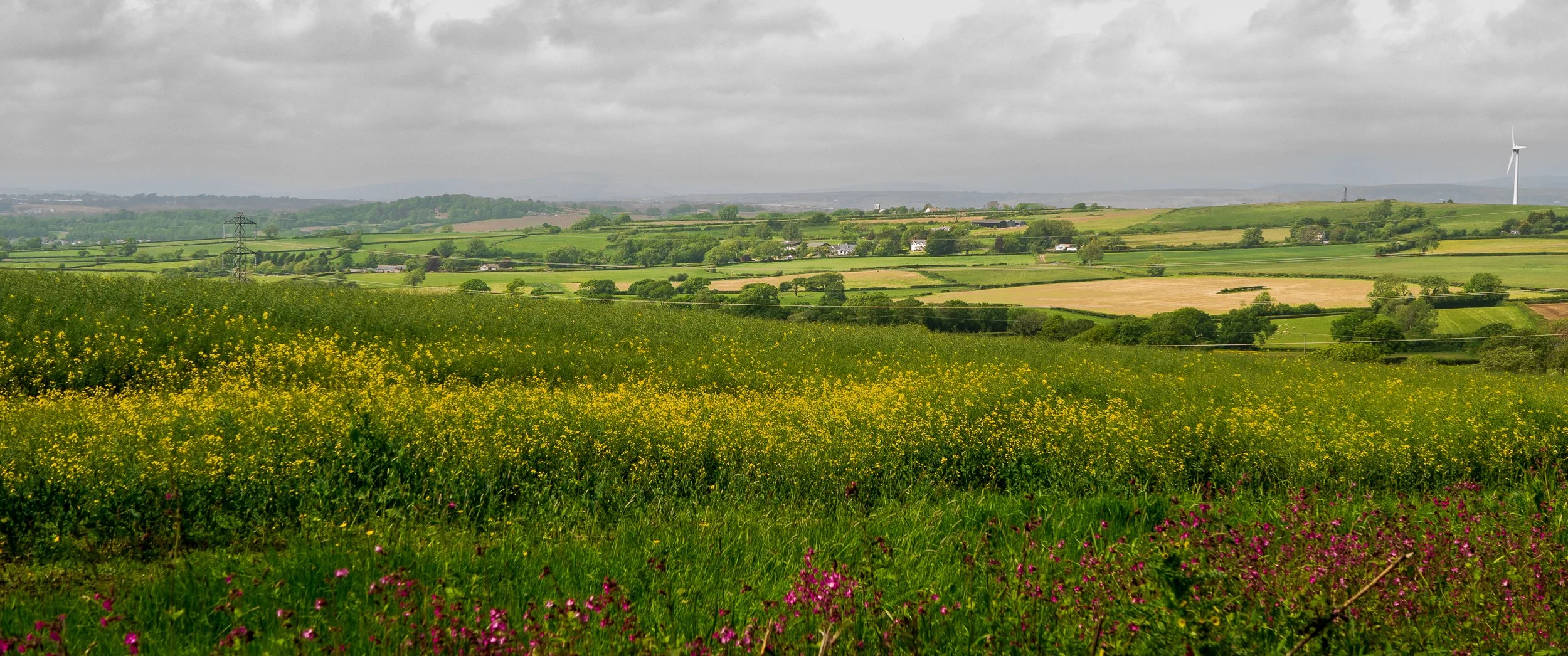
The Yellow Field & Rolling Hills
We began our loop just where the houses of Graig Penllyn peter out and the modern tarmac gives way to the older, gravelled farm tracks. The transition is always sudden here; one minute you are walking past neat garden hedges and the next you are standing at a rusted iron gate, looking out over a valley that seems to stretch out forever under a heavy, pale sky.
The very first thing that hits you at this time of year is the sheer, uncompromising volume of the yellow. It’s a dense, saturated blanket of rapeseed that looks almost artificial against the standard, muted greens of the surrounding hills. Under the soft, diffused light of an overcast May afternoon, it acts like a pool of bright paint catching whatever ambient light is filtering through the cloud layer.
We stood by the gate for a minute or two, letting the dog investigate the base of a rotten fence post with the intensity of a forensic scientist. In the immediate foreground, the lane was choked with wild growth—thick, dark grasses interspersed with the deep, magenta heads of red campion. We unlatched the gate, stepped onto the dirt path, and let the yellow margin guide us inward.
The Hamlet in the Hollow
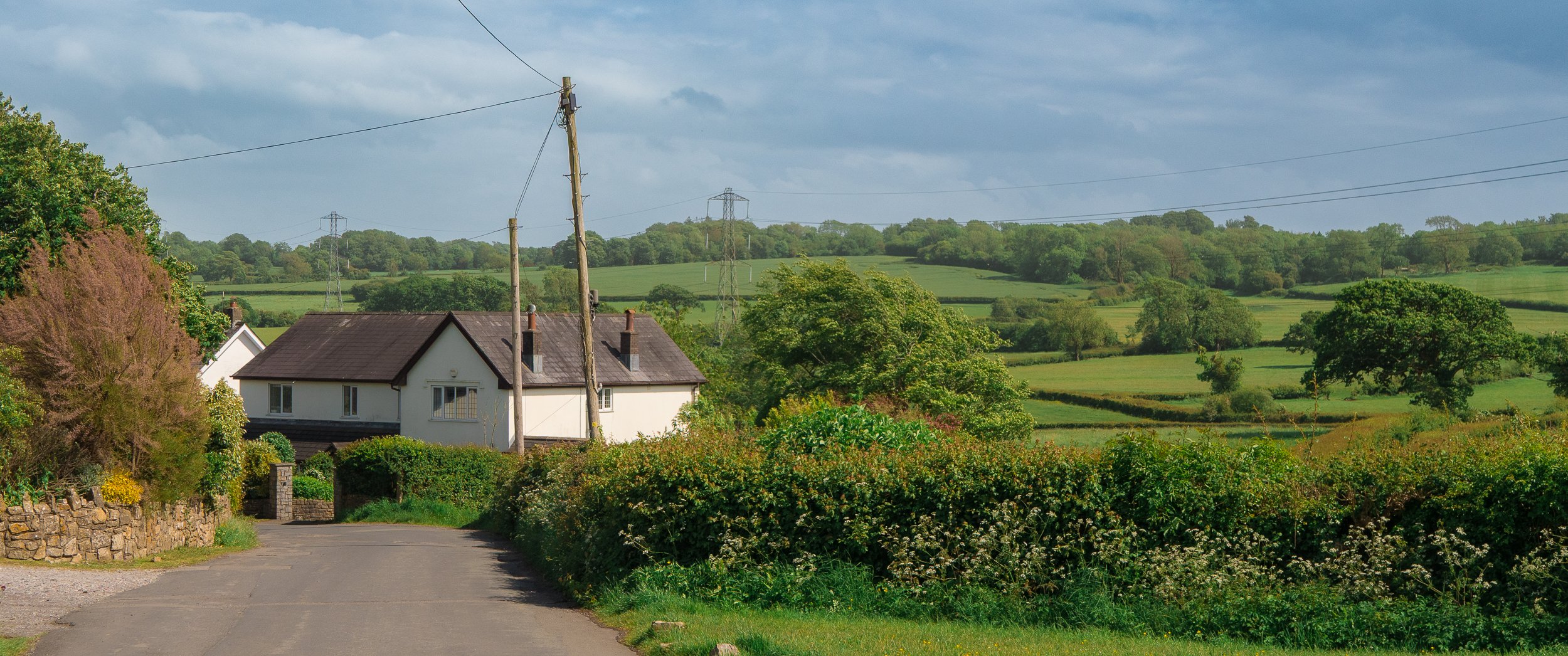
The Lane and House
As the track began to climb in a gentle, dragging slope toward the high ground of St Mary Hill Down, the perspective shifted. Reaching the crest of the first ridge, we looked back and saw the little hamlet we had just left behind, now nestled neatly into the very bottom of the valley hollow.
From up here, the village was a tight, compact cluster of light-coloured houses, their white and cream facades gleaming quietly against the vast, sweeping patchwork of the Welsh meadows. It’s a view that carries the weight of comfort and continuity—the sense that this valley has looked precisely like this for a very long time, and will likely continue to look this way long after our boots have worn through their soles.
A couple of electricity pylons strode across the fields on the left, their steel latticework looking surprisingly delicate against the massive scale of the hills. Some photographers might have tried to clone them out, seeking some pure, mythic version of an untouched rural paradise. But the pylons belong there; they are part of the reality of a living, working landscap
The Guardian of the Track
Every good walk has its landmarks—not the famous ones that appear on brown tourist signs, but the small, quiet markers that tell you you’re making progress. Leaving the wide vistas behind, the path squeezed between two old earthen banks, and there, dominating the track, was a magnificent, ancient oak tree.
It was a proper, old-fashioned guardian of a tree, its trunk so thick and deeply furrowed with age that it looked more like a geological feature than a living plant. The air beneath the canopy felt instantly cooler, smelling faintly of old wood, leaf mould, and wild garlic.
The dog, who had been trotting along with a sort of loose, casual indifference, suddenly became incredibly focused. To a Labrador, a tree of this vintage isn't a subject for aesthetic appreciation; it’s a vertical library of local news. While he buried his nose into a mossy crevice, Jayne leaned her back against the bark, taking a brief pause to adjust her jacket and declare that I was carrying the map upside down. I wasn't, but it’s best not to break the rhythm of the walk with technicalities.
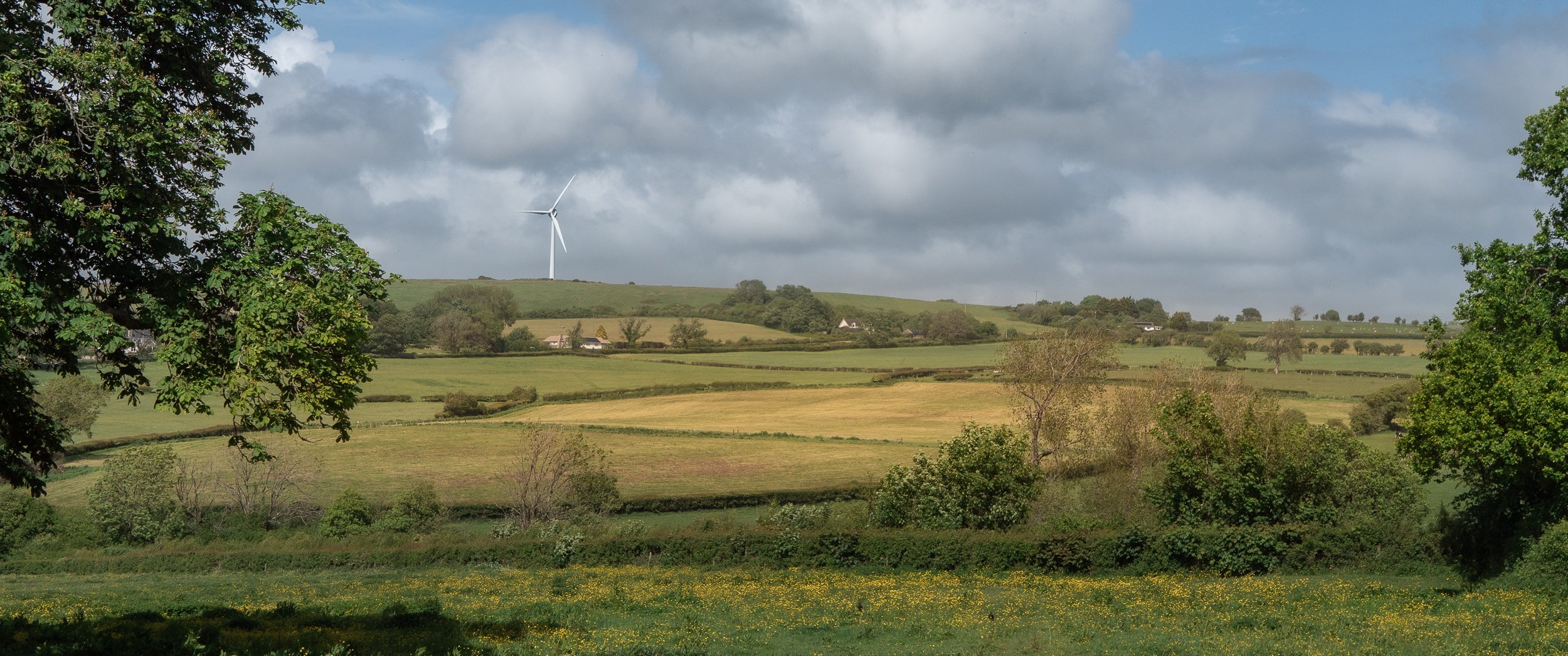
The Sunlit Meadow and Windmill
The Modern Skyline
Emerging from the shadow of the oak, the path flattened out onto a high, exposed ridge that gave us our longest view of the afternoon. Here, the landscape expanded again, rolling away toward the horizon in a series of long, gentle ridges that seemed to lose their color as they receded into the grey afternoon haze.
In the far distance, on the right-hand horizon, a single white wind turbine stood against the pale sky. It sat there with a quiet, functional indifference, spinning out clean energy while the sheep graze unbothered in the fields below it.
The light at this point had settled into a beautiful, soft monotony. The clouds were a solid, seamless sheet of pale grey, casting no shadows. It’s the kind of light that many landscape photographers despise because it lacks drama, but for a walk like this, it allows you to see the true, unvarnished color of the fields—that deep, rich, reliable Welsh green that only comes from a territory that receives its fair share of rai
The Industrial Sentinel
As we neared the final leg of the high ground, the landscape offered up one last, surprising landmark. Standing completely solitary in the middle of a wide field, surrounded by a low hedge, was a tall, square-sectioned stone chimney.
It is a striking thing to come across in the middle of a purely agricultural view. There are no other buildings around it—just a perfectly preserved monument of industrial stone rising straight out of the earth like an ancient obelisk. It is a remnant of the region's lead mining past, a quiet sentinel left behind when the rest of the works were dismantled.
There is a beautiful, wry sort of humor in the way the chimney sits there now. It was built to belch smoke into the sky, designed to dominate the landscape. Today, it has been completely domesticated by the Welsh countryside. The crows use the top of it as a lookout post, and the base of it is entirely choked with the same yellow rapeseed and wild weeds that fill the rest of the valley.
### The Rhythm of the Lane
With the landscape frames secured, the path finally plunged down into the deep, subterranean world of the Welsh sunken lanes for the final stretch home.
The earth banks on either side rose up well above our heads, topped with tangled hedges that met across the middle to create a long, green tunnel. Down here, the air was thick with the sharp, unmistakable scent of wild garlic, the banks completely white with its small, star-shaped flowers.
Jayne took the lead, her pink top providing a brilliant, unforced splash of color against the overwhelming green of the lane. The dog trotted just ahead of her on a loose lead, his golden coat catching the dappled light. He had that specific, purposeful stride that dogs get when they realise they are on the homeward leg of a journey—a steady, optimistic trot driven by the absolute certainty that a bowl of kibble and a dry rug are waiting for him just around the next bend.
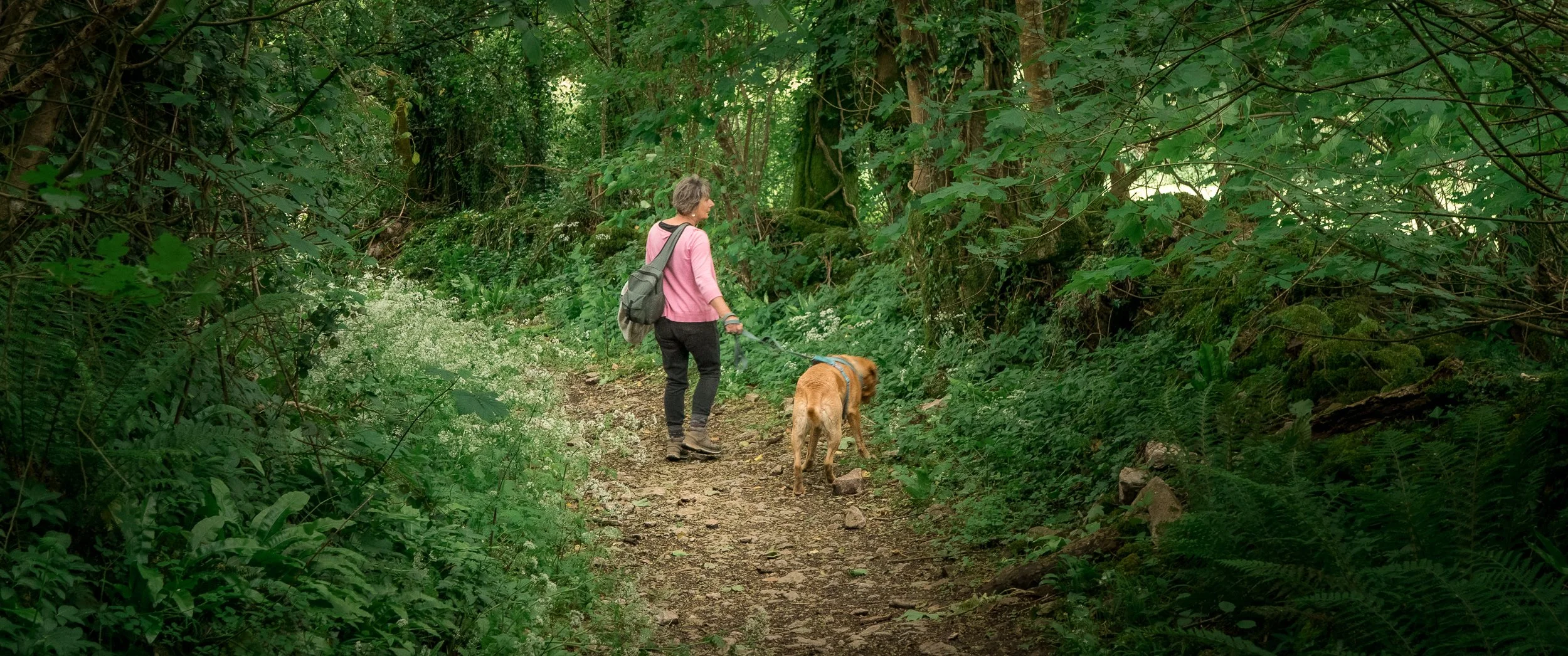
Jayne and Toby
I fell back a dozen paces, letting the two of them pull ahead until they were perfectly framed by the overhanging branches. This is the photo that means the most to me from the entire afternoon. It’s the visual definition of what these trips are actually about: the quiet, comfortable rhythm of two people and a dog moving through a quiet place together, entirely content with the pace of the day.
A Quiet Ending
We emerged from the lane about twenty minutes later, the track turning back into smooth tarmac as it guided us past the first few outlying cottages of Graig Penllyn. A black dog behind a stone wall gave us a brief, formal bark just to satisfy its sense of duty, before returning to its position on a sun-warmed flagstone.
We didn't say much as we reached the car and began the unglamorous ritual of swapping muddy walking boots for sensible driving shoes. The dog climbed into the boot, let out a massive, theatrical sigh that shook his entire frame, and was asleep before I’d even turned the key in the ignition.
There was no grand conclusion to be drawn from the afternoon. We had simply spent two hours wandering through five miles of quiet Welsh countryside, watching the light change across the fields and letting the lanes lead us where they wanted. When we look at these photographs a year from now, we won’t see a curated photography project. We will simply see our afternoon—honest, unhurried, and exactly as it happened.