
From Southerndown to Monknash: Toby Leads the Way
There are many dignified ways to explore the Welsh Heritage Coast.
You can study the geology. You can admire the cliffs. You can pause to appreciate the changing light, the sweep of the tide and the ancient relationship between land and sea.
Or you can bring Toby, who will ignore all of that because he has seen a rock.
This particular adventure began when Toby and I got off the bus at Southerndown, intending to walk along the beach towards Monknash. I had a camera, sensible footwear and what I believed was a reasonable plan.
Toby had four legs, unlimited enthusiasm and no interest whatsoever in plans.
The route sounded straightforward enough: get off the bus, head towards the coast, walk along the beach and eventually arrive at Monknash.
That was the human version.
Toby’s version was: get off the large moving box, inspect every hedge, locate the sea, run at full speed, find unsuitable objects and behave as though this was the greatest day in recorded history.
Arriving in Southerndown
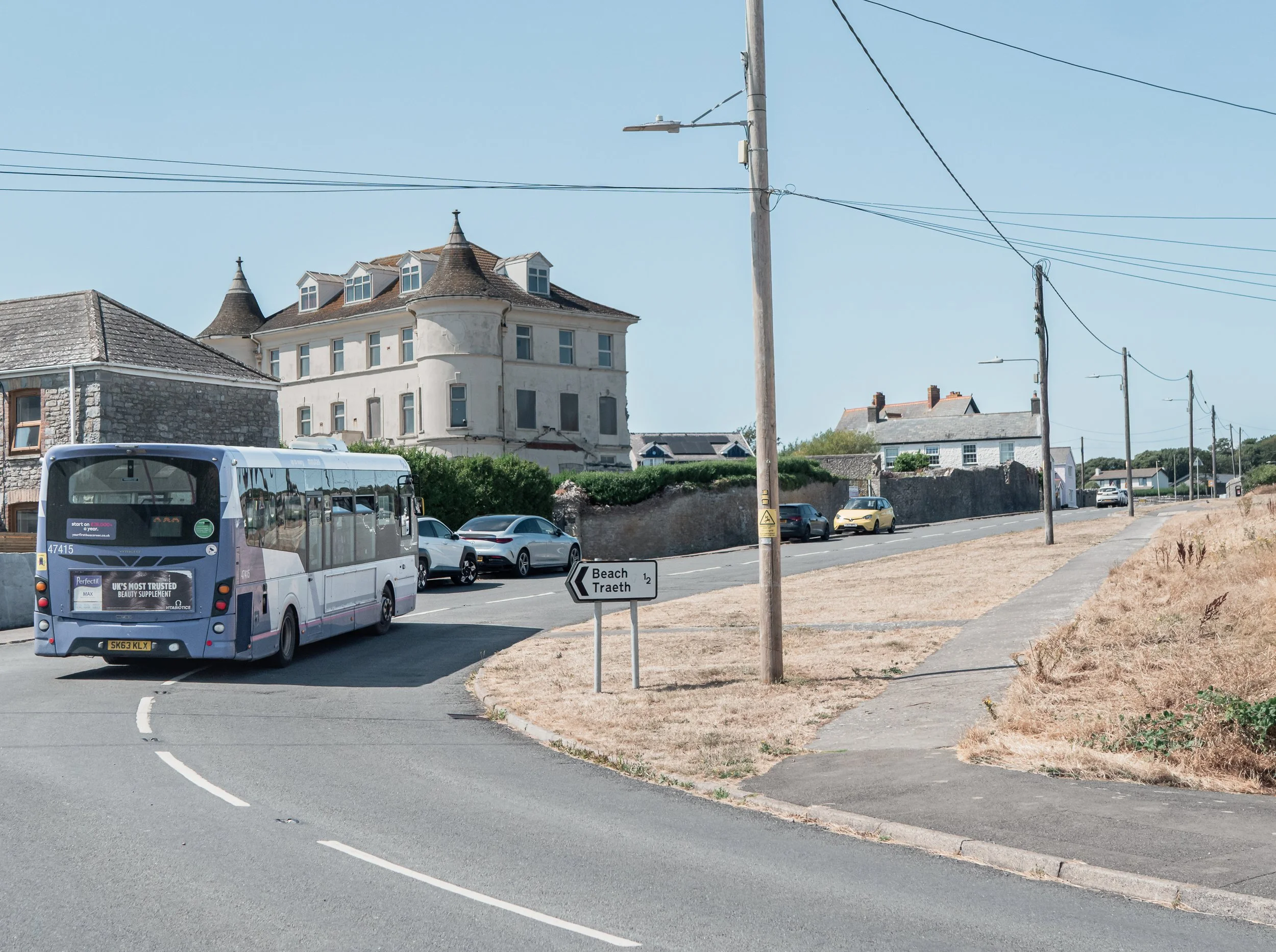
Stepping off the bus at Southerndown, Toby and I began our coastal walk towards Monknash — with no idea that one very important rock was waiting for us.
Our first photograph of the day was not the sweeping Welsh coastline I had imagined.
It was a bus.
There were also houses, parked cars, road signs, telegraph poles and enough overhead wires to suggest that someone had tried to knit the entire street together.
The bus rounded the corner beneath a bright sky while a small sign pointed towards the beach. It was an ordinary scene, but it marked the true start of the walk. We had arrived in Southerndown and, more importantly, we had got off the bus successfully with all essential equipment present.
Camera: present.
Bag: present.
Toby: physically present, mentally already on the beach.
The benefit of arriving by bus is that there is no car waiting for you at the end of the walk. The disadvantage is also that there is no car waiting for you at the end of the walk.
This adds a useful sense of commitment.
Once the bus had gone, there was no temptation to return early because the wind had become annoying or because Toby had discovered a new fragrance and wanted to spend twenty minutes analysing it. We were going to Monknash.
Probably.
The first image captured something I rather like about British coastal trips. The sea does not always reveal itself in a grand cinematic flourish. Sometimes you arrive beside a road, squeeze past parked cars and follow a sign while a telegraph pole dominates the composition.
That is the authentic seaside experience.
It is landscape photography with public transport.
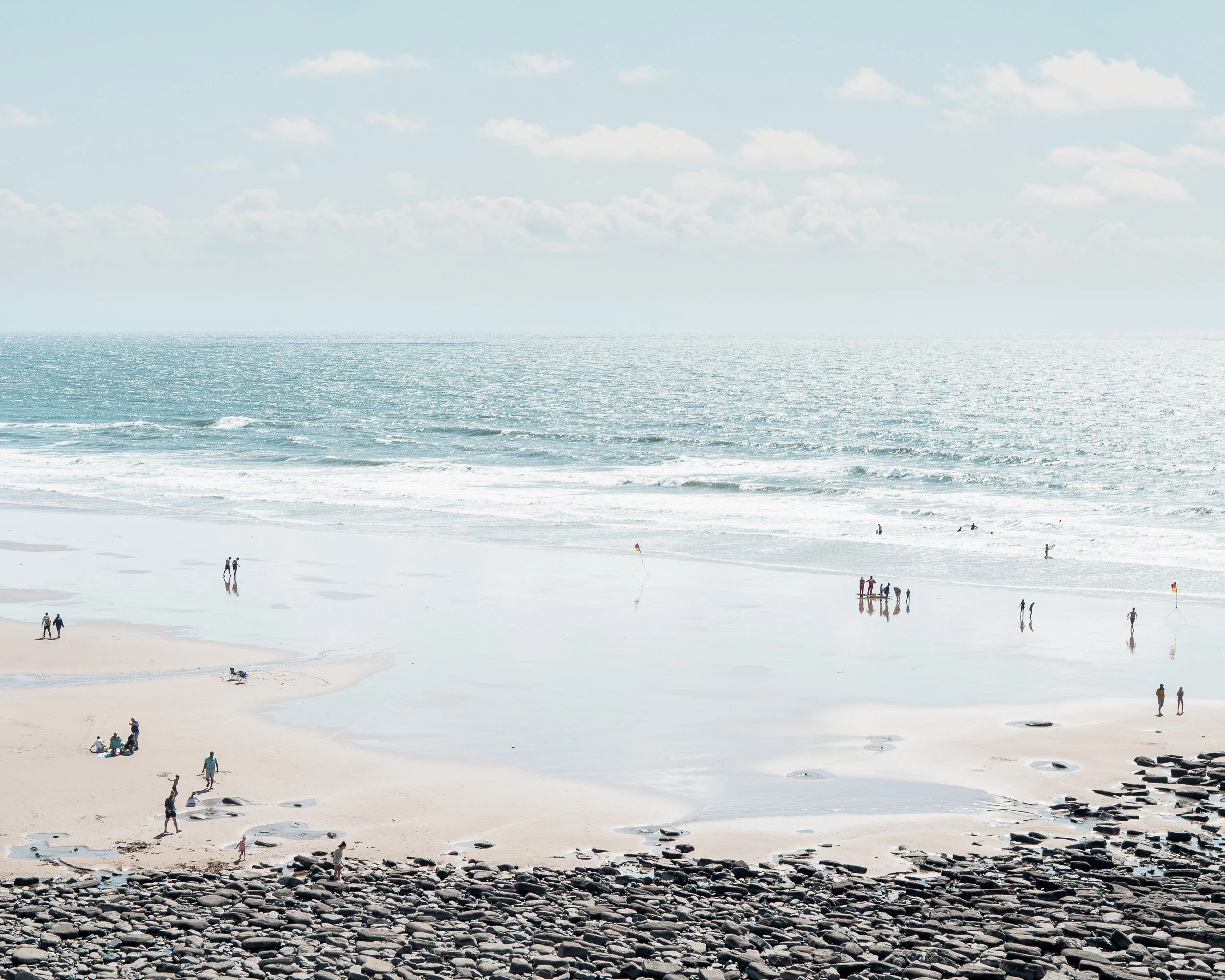
Looking down across the shore at Southerndown, where summer visitors, surfers and rock pools spread out beneath the pale Welsh coastal light.
Looking Down on Southerndown Beach
Before Toby and I properly set off along the shoreline towards Monknash, we stopped to look down across Southerndown Beach.
From above, the beach looked wonderfully busy without feeling crowded. Small groups were scattered across the wet sand, surfers waited in the shallows, and walkers moved between the pools left behind by the retreating tide. From that height, everyone looked tiny, as though the sea had arranged them carefully across the beach for the photograph.
The pale Welsh light softened the whole scene. The sky, water and reflective sand blended into gentle shades of blue, silver and cream, while the darker rocks in the foreground added some much-needed structure. It was one of those views that made the coastline feel enormous and made all of us on it look slightly ridiculous by comparison.
Toby, naturally, was not interested in admiring the composition.
While I watched the surfers and tried to decide whether the light was atmospheric or simply very bright, he was already focused on reaching the beach. Somewhere below were rocks, water, seaweed and countless things that would apparently require urgent investigation.
The photograph became a useful pause in the story of the walk. It showed where we were heading before we descended to beach level and began the journey towards Monknash. From above, the route looked calm, spacious and inviting.
At ground level, it would involve slippery rocks, wet paws and Toby developing a powerful emotional attachment to one particular stone.
The path to Monknash, we followed a shaded path towards the coast.
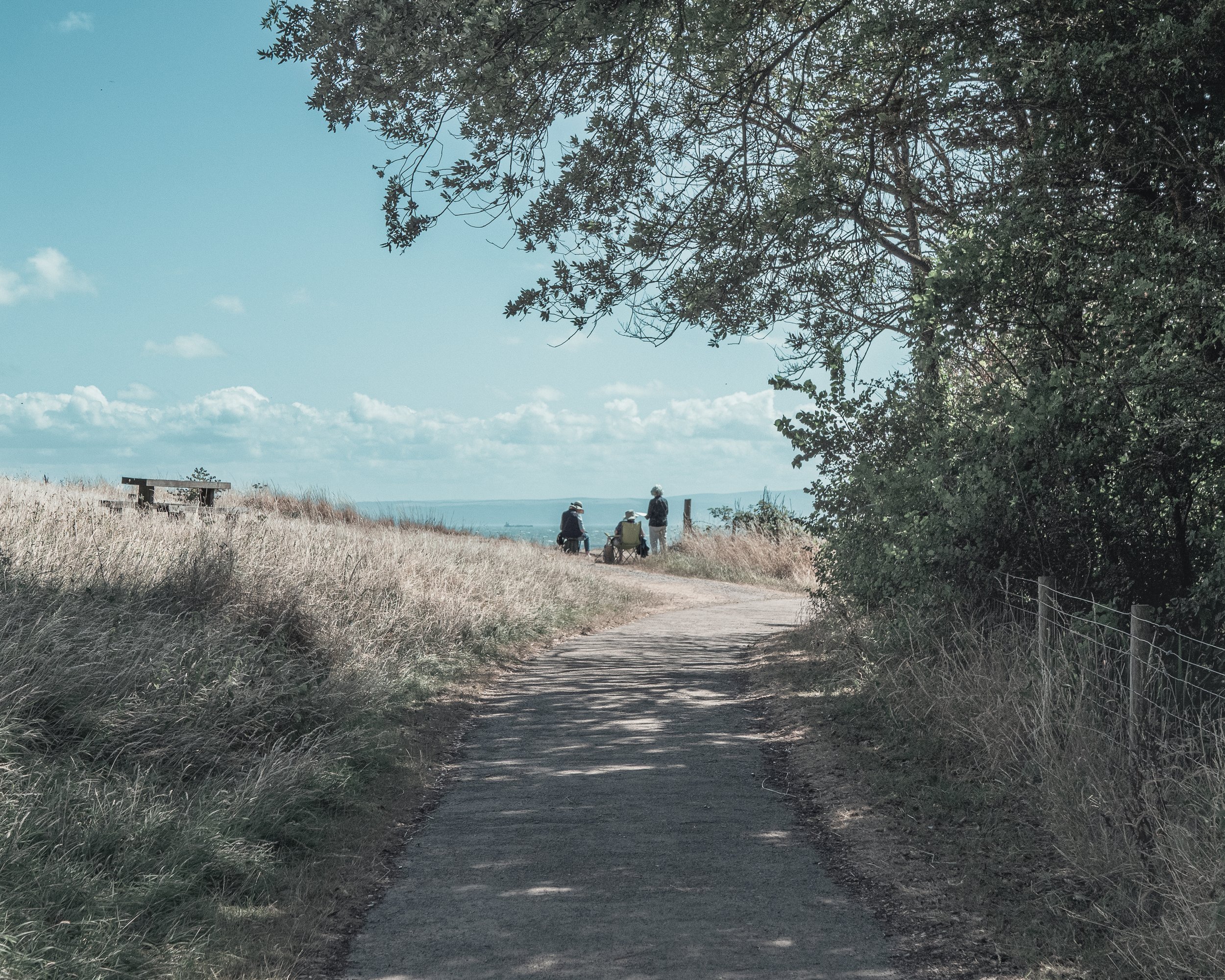
Along the shaded path above Southerndown, a small group of artists paused to sketch the Welsh coast while Toby remained far more interested in getting down to the beach.
The lane curved under trees, with broken light falling across the ground. Ahead, the path opened into bright sunshine and dry grass, and beyond that was the first glimpse of the sea.
Toby immediately increased his walking speed.
Dogs seem to know when they are approaching water. I do not know whether they smell the salt, hear the waves or simply recognise the expression of mild concern on their owner’s face.
Whatever the method, Toby knew.
The path made a strong photograph because of the contrast between the cool shade and the bright coastal opening. The eye naturally followed the lane towards the figures in the distance and the narrow glimpse of blue beyond them.
Toby also followed the lane, although less naturally.
His route involved several unnecessary diversions, a detailed inspection of the verge and one sudden stop that nearly converted me into an airborne object.
A dog lead is not merely a restraint. It is a communication device through which your dog can send urgent messages directly to your shoulder.
The message that morning was: “There is something important in this grass.”
There was not.
The mysterious people with chairs
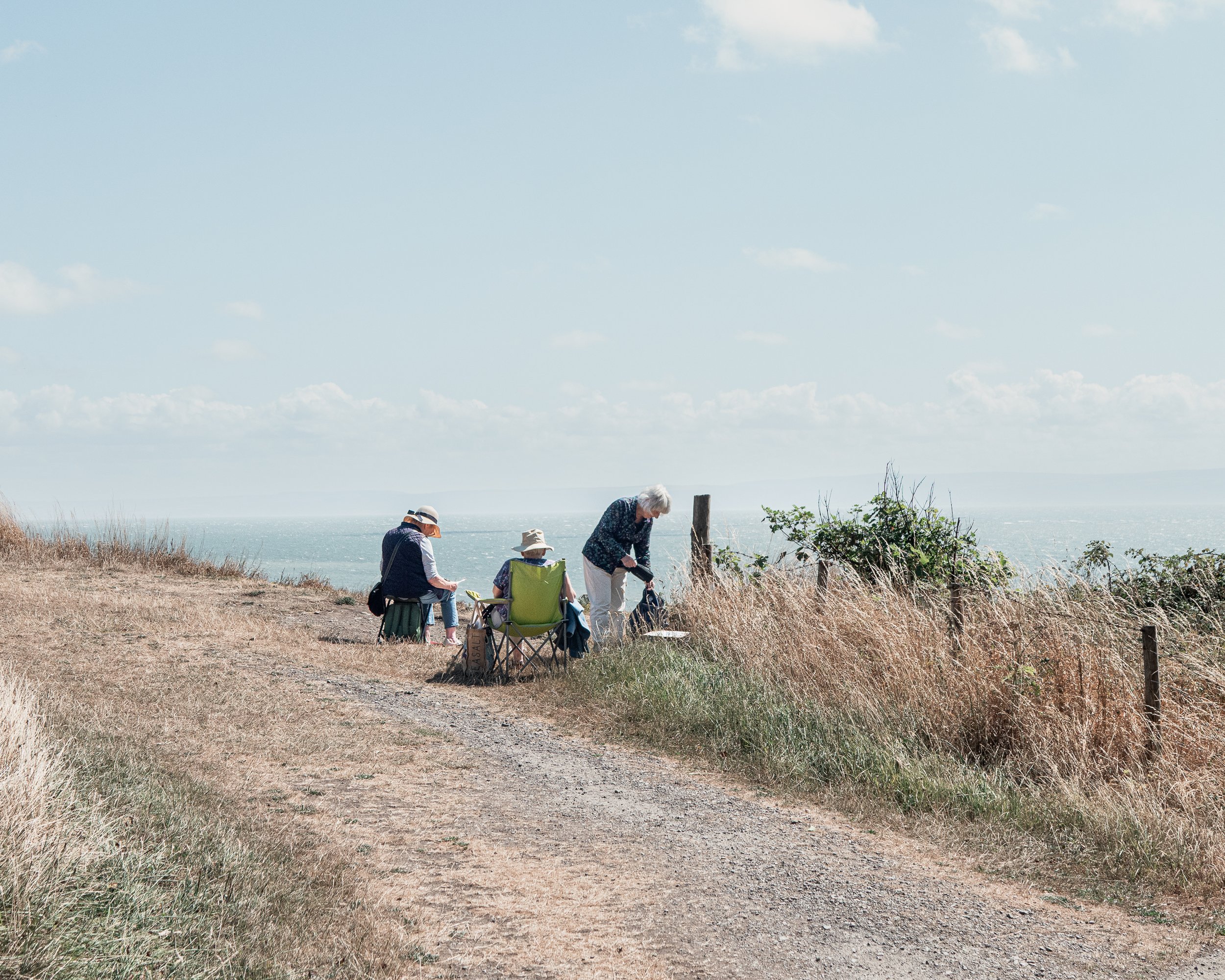
A quiet clifftop sketching session above Southerndown, while Toby and I continued towards the beach and the next part of our Monknash adventure.
Near the end of the path, a small group of people sat in folding chairs overlooking the coast.
At first, I thought they were simply enjoying the view.
Then I thought they might be having tea.
Then I realised they appeared to be drawing.
This was a charming scene. The group had arranged themselves among the dry clifftop grass, facing the sea with sketchbooks and bags around them. One person stood and leaned forward, while the others remained seated.
They looked calm, thoughtful and artistically engaged.
Toby looked at them briefly and concluded that they were not throwing anything.
We moved on.
There is something wonderful about people sitting quietly and drawing the coast. They were taking time to observe the landscape carefully, studying its shapes and tones before translating it onto paper.
I, meanwhile, took several photographs in quick succession while trying to prevent Toby from entering the composition at speed.
Different artistic methods.
The sketchers had patience, discipline and folding chairs.
I had autofocus and a lead wrapped around my wrist.
Still, the scene became an important part of the story. It showed another way of experiencing the coast. Some people sit and study it. Some walk through it. Some photograph it.
Toby attempted to eat part of it.
Down to the beach
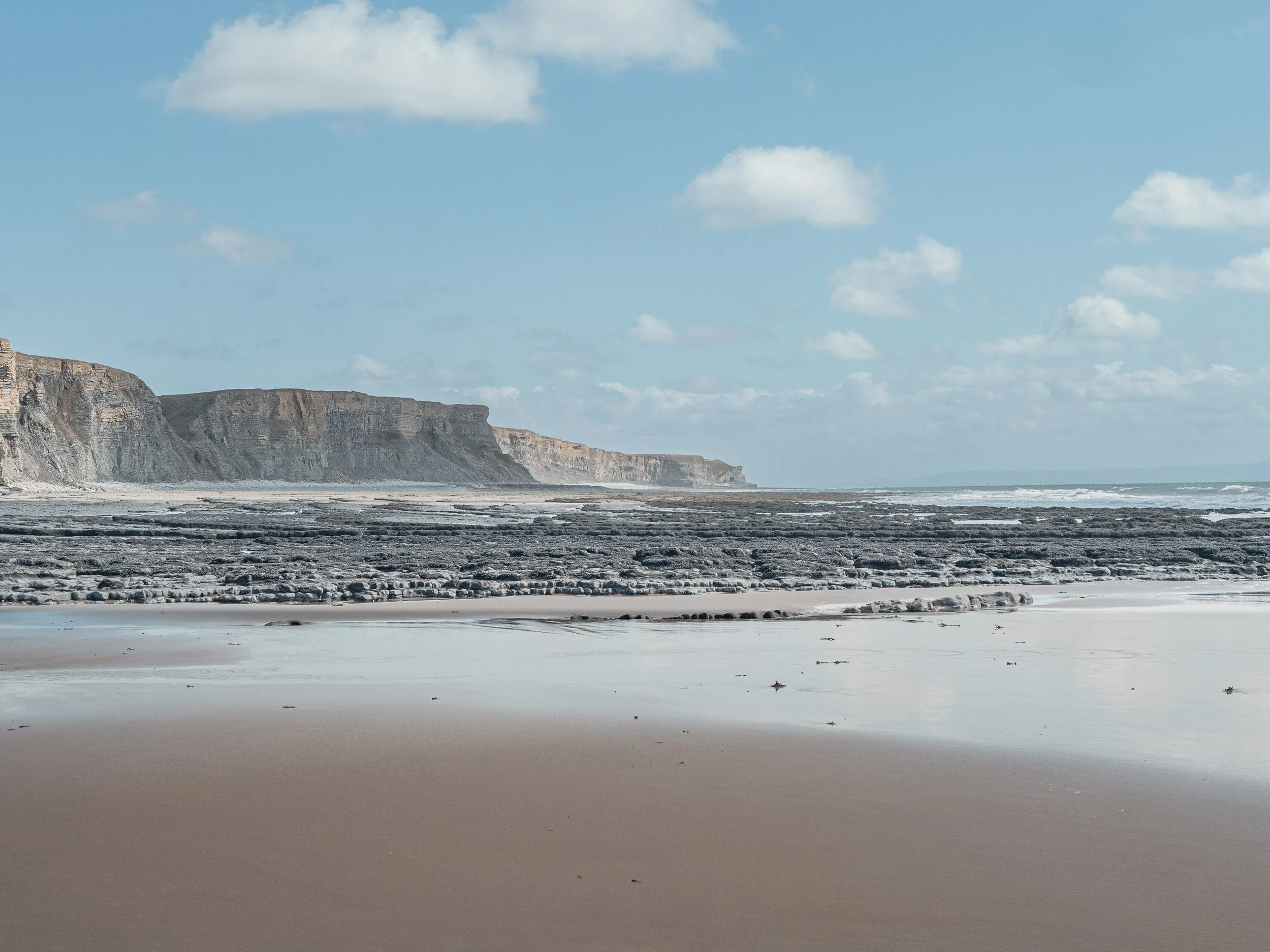
Low tide beneath the cliffs at Southerndown, where wet sand and exposed rock shelves marked the beginning of our beach walk towards Monknash.
Once we reached the beach, the walk changed completely.
At the top of the cliffs, the coast had felt open and distant. At beach level, it became textured, uneven and considerably more interested in our ankles.
The tide was low, revealing long rock shelves, shallow pools, wet sand and channels of water. The cliffs stretched into the distance, their layers softened by haze.
It was an ideal landscape for photography.
It was also an ideal landscape for discovering that every rock is slightly more slippery than it looks.
The beach offered endless compositions. Dark rock shelves created horizontal lines. Wet sand reflected the pale sky. Small pools caught patches of blue. The cliffs added scale and direction.
Toby contributed paw prints, sudden movement and an almost supernatural ability to stand exactly where I did not want him.
Whenever I raised the camera towards the cliffs, he entered the frame.
Whenever I turned the camera towards him, he turned away.
This is the basic principle of dog photography.
The light was bright and hazy, creating a soft, slightly faded palette. The sea was pale blue-grey, the cliffs muted and the sand almost silvery in places.
It was not dramatic light, but it had atmosphere.
Toby did not care about atmosphere.
He had found a smell.
Following the cliffs towards Monknash
We continued along the beach with the cliffs on one side and the sea on the other.
This sounds poetic until you remember that between those two impressive natural features were several miles of rocks designed to test the structural integrity of human knees.
Walking along a beach beneath cliffs creates a strong sense of scale. The landscape feels immense, while the people moving through it seem tiny.
This is useful in photography because a small figure can provide context.
It is less useful when the small figure is your dog and he has disappeared behind a rock.
“Toby!”
A head appeared.
Then vanished again.
The cliffs guided us towards Monknash, becoming paler in the distance. The broad rock platforms were broken by pools and narrow water channels. Waves rolled in farther out, while the exposed beach formed a temporary landscape between tides.
I stopped regularly to take photographs.
Toby stopped regularly because I had stopped.
He then looked at me with the weary expression of a professional hiking guide whose client had once again become distracted by clouds.
The truth is that photographing a walk makes progress slow. Every bend reveals another possible composition. Every reflection becomes interesting. Every arrangement of rocks suggests a foreground.
A normal person might look at the coast and think, “That is lovely.”
A photographer thinks, “That is lovely, but would it be better from six feet to the left, lower down, at 35mm, with a slightly tighter crop?”
Toby thought, “Can I drink this?”
Toby among the rock pools
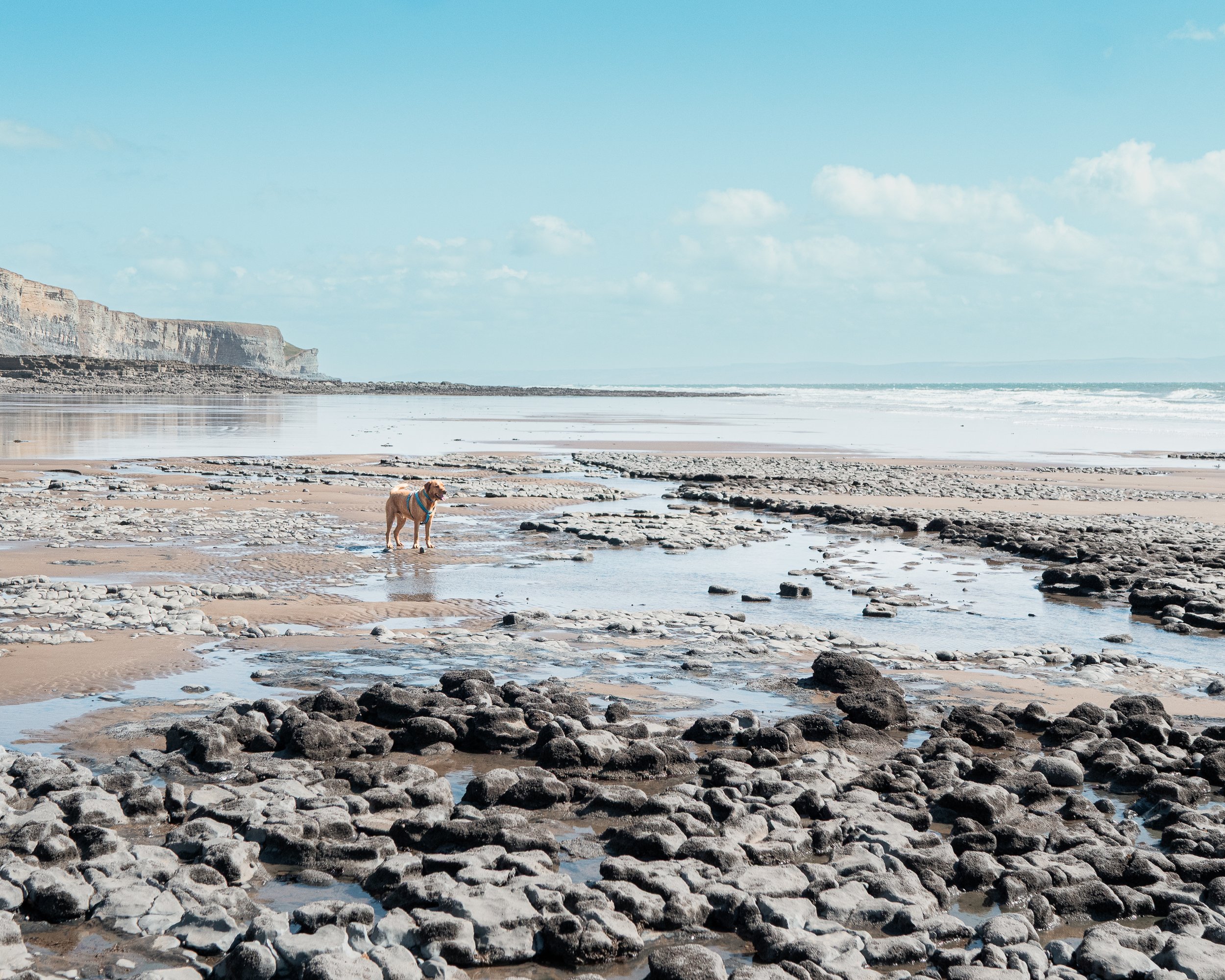
Toby pauses among the rock pools below Southerndown, briefly pretending to admire the Welsh coast before choosing his next stone to chase.
One of my favourite images from the walk shows Toby standing among the rock pools.
The cliffs appear in the distance, and the foreground is filled with stones, wet sand and shallow channels of water. Toby is small within the landscape, but his warm coat makes him easy to find.
He stood alert, looking across the beach.
This gives the photograph a calm, thoughtful quality.
It suggests he was contemplating the coastline.
He was not.
He had seen something.
I did not know what it was, and there was every chance he did not know either, but it had become extremely important.
Dogs can transform an ordinary object into a major event simply by staring at it.
A stone becomes suspicious.
A piece of seaweed becomes an intruder.
A drifting leaf becomes a crisis requiring immediate pursuit.
In the rock-pool photograph, Toby appears like an experienced explorer assessing the terrain ahead.
Seconds later, he was splashing through shallow water with no plan at all.
That is why the image works so well. It captures the brief moment between chaos.
Following the Shore
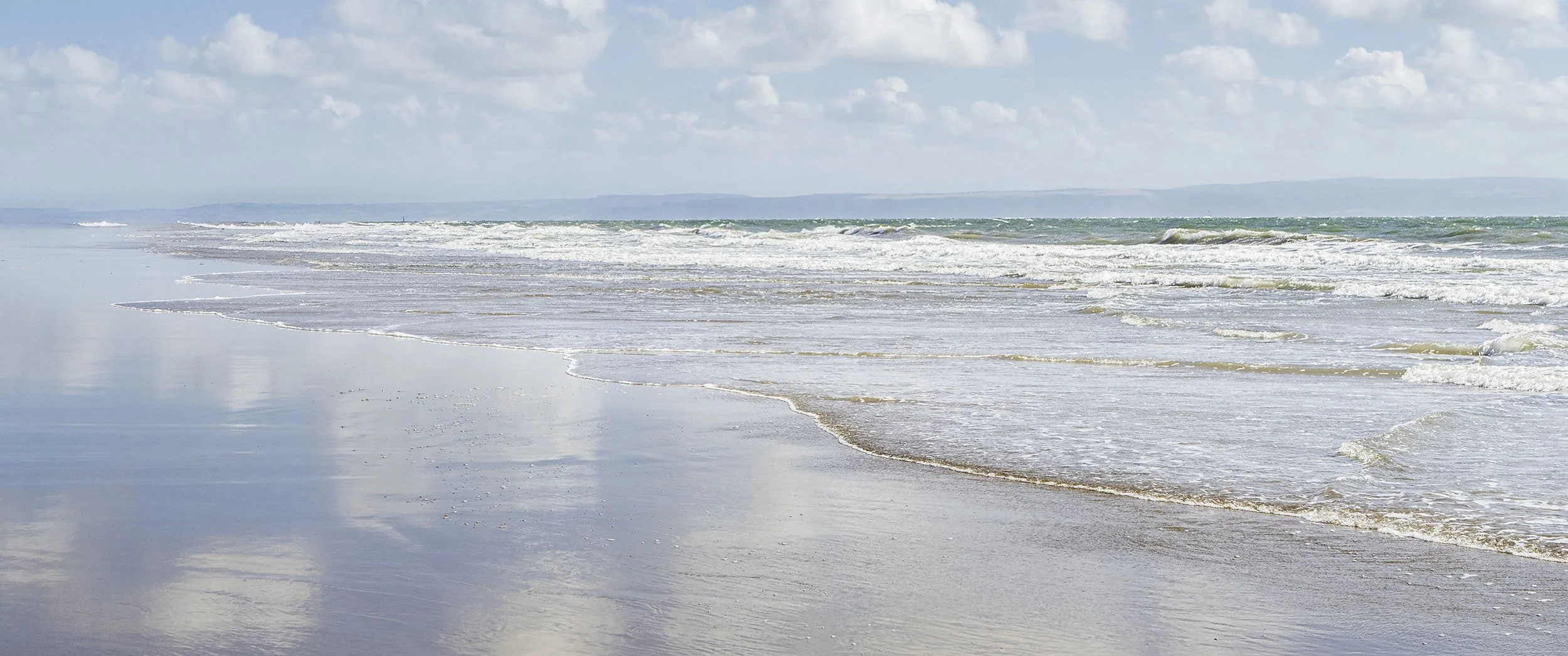
The tide traces a silver path along the Welsh shore, guiding Toby and me onwards towards Monknash.
As Toby and I continued along the beach towards Monknash, the tide left a gleaming ribbon of wet sand ahead of us. The clouds reflected beautifully in the shallow water, while the waves rolled in with considerably more urgency than either of us felt. I paused to enjoy the view and take a photograph; Toby paused because he had spotted yet another object requiring immediate investigation. The broad, open shoreline made the walk feel wonderfully spacious, although Toby’s route was less “straight towards Monknash” and more “zigzag wildly between every promising smell, stone and patch of seaweed”.
The rock incident
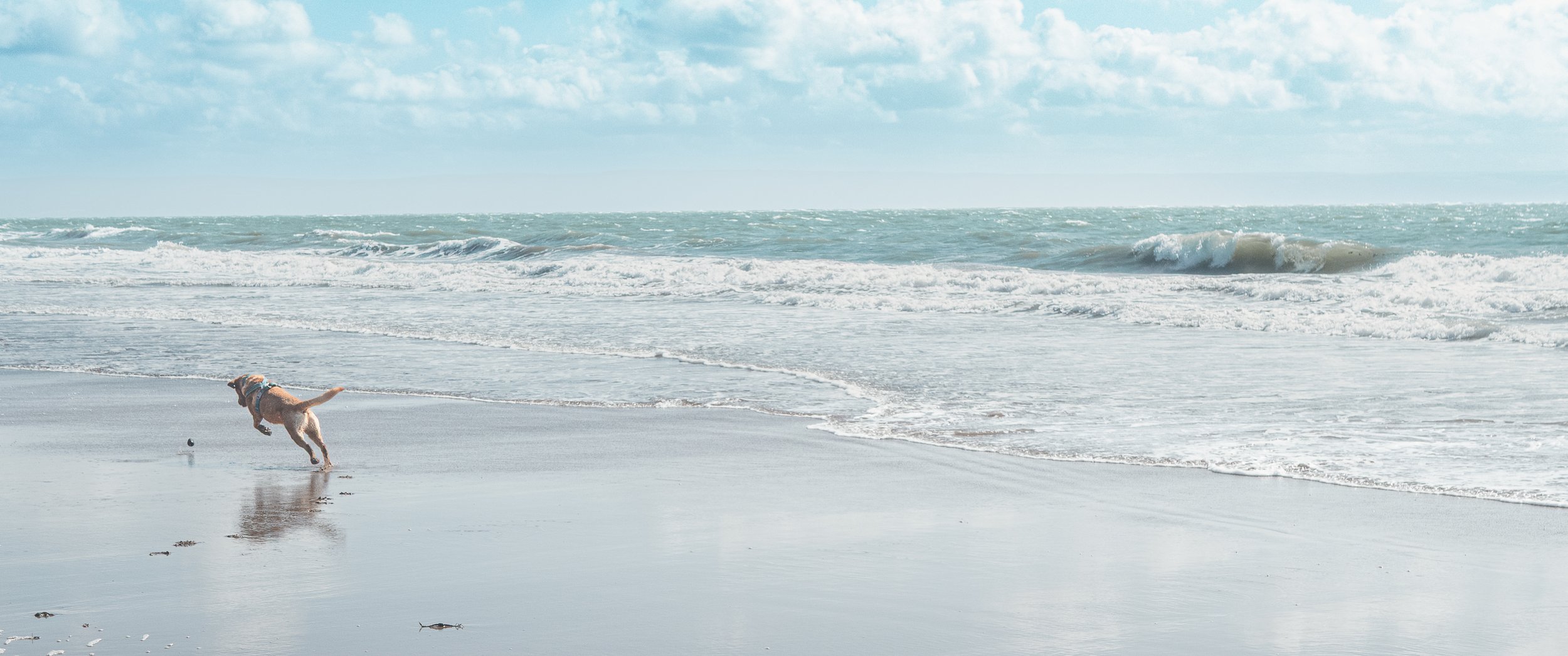
Toby launches himself after the day’s most important rock, leaving me to photograph the emergency from a safe distance.
Eventually, we reached a wide stretch of wet sand near the waterline.
The waves were rolling in, the surface of the beach reflected the sky and there was plenty of open space.
This was when Toby found the rock.
Not an unusual rock.
Not a beautiful rock.
Not a rock of geological importance.
Just a rock.
It may not even have been a rock. It could have been a compact lump of beach material that had achieved temporary significance.
Whatever it was, Toby wanted it.
He launched himself across the sand with the absolute commitment of an Olympic athlete who had just been informed that the prize was edible.
For one glorious moment, all four paws left the ground.
His body stretched forward, his tail flew behind him and his attention remained fixed on the object ahead.
This was the moment I caught in the photograph.
The sea rolled in behind him. The wet sand produced a faint reflection. The pale blue sky and breaking waves created a broad, airy background.
Toby was in full flight.
The rock remained unimpressed.
Photographing a dog who does not take direction
Animal photography requires patience, anticipation and a subject who understands what you are trying to achieve.
We had two of those.
I would have liked Toby to run parallel to the waves in attractive side light, ideally through a shallow reflective layer of water.
Toby would have liked the rock.
I would have preferred a clean background.
Toby would have preferred to change direction without warning.
I wanted a sequence of sharp action photographs.
Toby wanted to accelerate directly out of the frame.
The successful image exists because, for a fraction of a second, our separate creative objectives overlapped.
He chased the rock.
I pressed the shutter.
Teamwork.
The wide composition was important. I could have cropped closely around Toby, but the surrounding space gave the image its sense of freedom. The sea, clouds and empty sand showed the environment through which he was running.
It was not simply a photograph of a dog.
It was a photograph of a dog having the best possible opinion of his own day.
The British weather behaves suspiciously well
The weather was bright, breezy and surprisingly cooperative.
This is always concerning.
Welsh coastal weather is perfectly capable of presenting sunshine, rain, wind and a personal insult within the same fifteen minutes.
On this occasion, the sky stayed pale blue, with soft clouds stretched above the sea. The light remained strong but hazy, giving the photographs a consistent look.
Naturally, this made me suspicious.
I kept expecting a dark cloud to appear from nowhere and begin travelling directly towards us with administrative purpose.
It did not.
Instead, we had one of those rare days when the weather seemed to understand the assignment.
The bright conditions created challenges for editing. The sky, surf and reflective sand were all close in tone, so the images could easily become washed out. Highlights needed to be controlled carefully, while the darker rocks and Toby’s coat needed enough shadow detail to remain visible.
The aim was to preserve the airy quality without making the pictures look as though they had been left in direct sunlight since 1974.
The long walk continues
After the rock incident, we carried on towards Monknash.
Toby remained energised.
I did not.
He had spent the morning running on sand, climbing over rocks and investigating every available scent. Somehow, he still moved as though the walk had only just begun.
I had carried a camera bag for several miles and was beginning to understand why professional landscape photographers frequently discuss the importance of lightweight equipment.
The beach continued to change beneath us. Firm sand gave way to loose stones. Rock platforms interrupted the route. Pools had to be crossed or walked around.
Toby approached each new section confidently.
I approached it while calculating the likelihood of dropping a camera.
There is a special form of walking used by photographers on slippery rocks. It involves bent knees, outstretched arms and the facial expression of someone trying to carry a tray of drinks across a moving train.
Toby watched this performance without sympathy.
A walk becomes a story
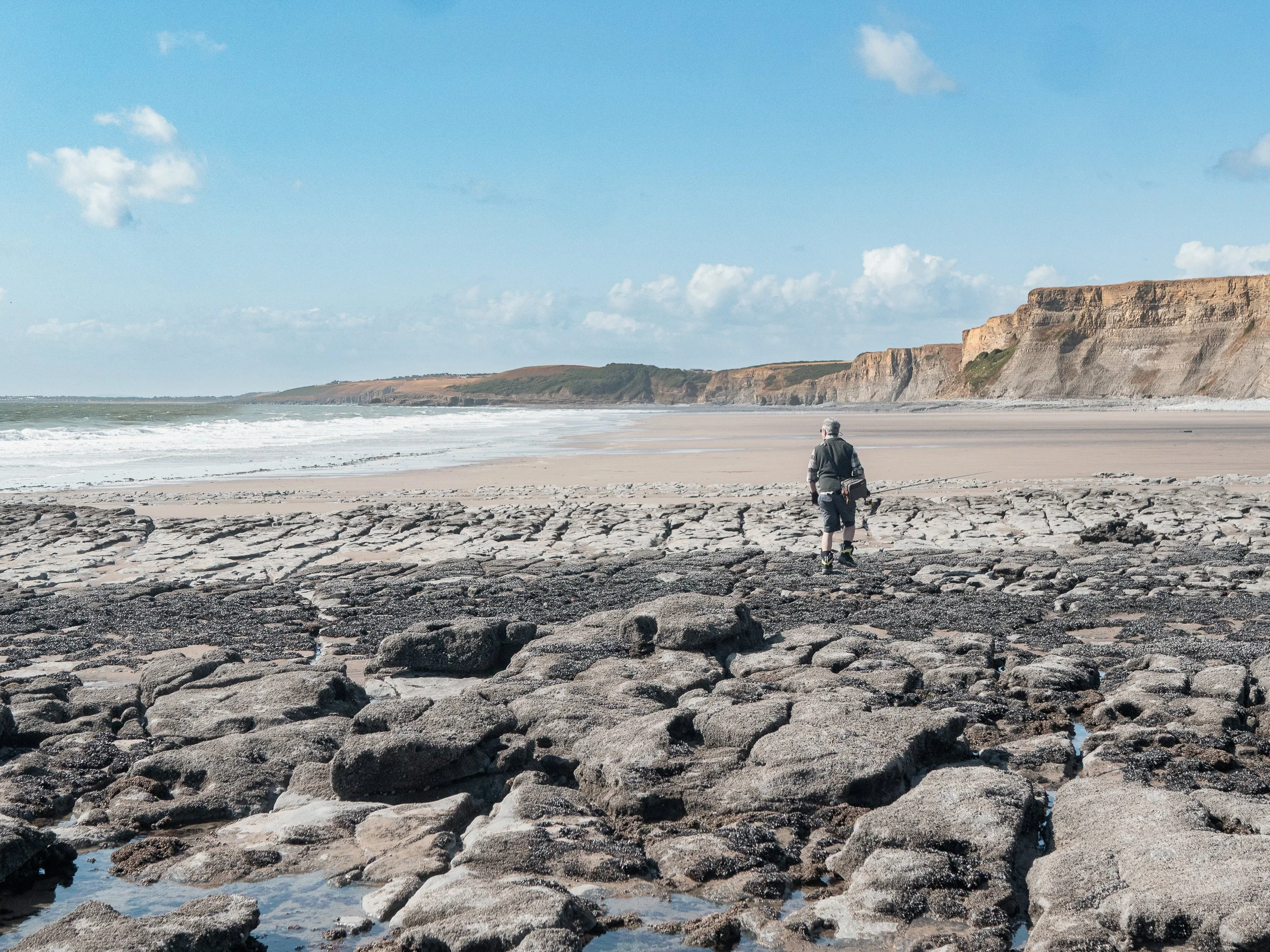
The first person we met on the beach after walking down from the headland — a welcome reminder that we were not the only ones tackling the rocks towards Monknash.
The real subject of the photographs was not simply the coast.
It was the journey.
We began beside a road in Southerndown after getting off the bus. We followed a shaded path towards the sea, passed a group of people sketching on the headland and descended to the beach.
We then walked beneath the cliffs, crossed rock shelves, explored pools and continued towards Monknash.
Toby appeared throughout the story in different roles.
At first, he was an impatient passenger.
Then an enthusiastic walker.
Then a rock-pool explorer.
Finally, he became a high-speed projectile pursuing a small object across the beach.
The landscape gave the photographs structure, but Toby gave them personality.
Without him, the images would still show an attractive section of the Welsh Heritage Coast.
With him, they record an adventure.
Admittedly, most of the adventure existed in Toby’s head.
Why dogs improve walks and complicate photographs
Walking with a dog changes the pace of a journey.
There are moments of sudden speed, long pauses and unexplained detours. Progress is not measured simply in miles but in trees inspected, puddles entered and objects chased.
This can be frustrating when trying to reach a destination.
It is also what makes the day memorable.
Toby noticed things I would have walked past. He encouraged pauses, even when those pauses occurred because he had found an interesting patch of seaweed.
He introduced movement into wide landscapes and humour into quiet scenes.
He also ensured that no photograph became too serious.
A large cliff can look ancient and imposing.
Put Toby beneath it, staring at a pebble, and the mood changes immediately.
Reaching Monknash
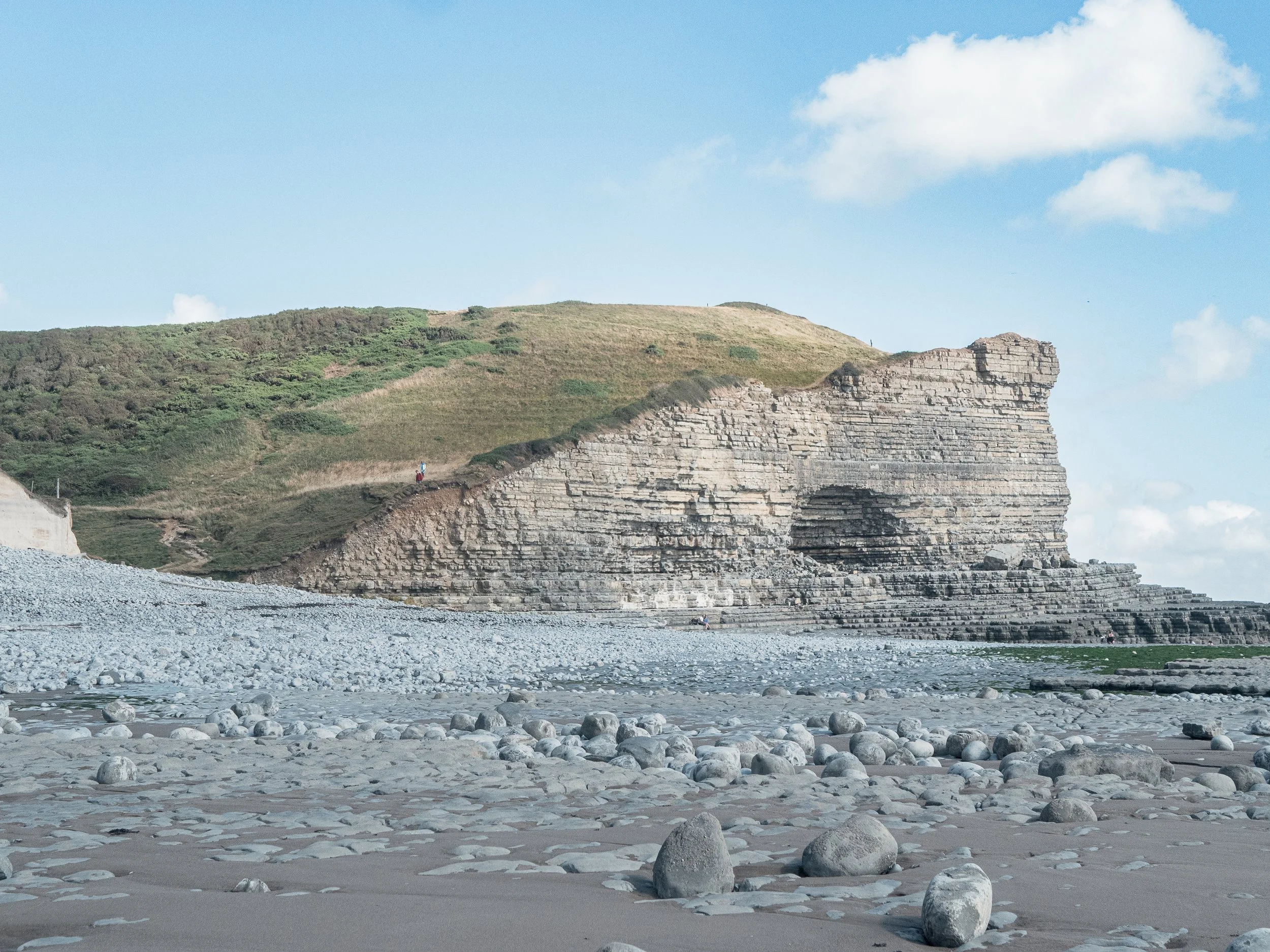
Ahead, the way off the beach towards Monknash came into view — a path leading into the valley beside the almost dried-up river on the left, with that well-deserved pint getting steadily closer.
By the time we approached Monknash, the walk had become a collection of small episodes.
There was the bus journey.
The shaded path.
The artists on the headland.
The cliffs.
The rock pools.
The chase.
There was also sand in places where sand should never be.
The arrival mattered, but it was not the most important part of the day. Monknash gave us a destination, yet the experience came from everything that happened between the two places.
That is one of the pleasures of walking a coastline rather than visiting a single viewpoint.
There is no one defining scene.
The landscape unfolds gradually, and the story builds through movement.
For Toby, the day could probably be summarised more efficiently:
Bus.
Beach.
Rock.
Perfect.
Toby’s official review
Toby was unavailable for a formal interview, but his opinion of the walk can be inferred from his behaviour.
Transport: acceptable.
Path: interesting smells.
Artists: insufficient throwing activity.
Beach: excellent.
Rock pools: excellent.
Seaweed: worth investigating.
Waves: loud but manageable.
Rock: outstanding.
Human companion: very slow.
Overall rating: five paws out of five.
A Welsh coastal adventure worth remembering
The walk from Southerndown towards Monknash gave us pale skies, open beaches, layered cliffs and the shifting textures of low tide.
It also gave me photographs that feel connected by more than location.
Together, they tell the story of a day spent moving through the landscape with Toby.
The first image shows the ordinary beginning: a bus, a road and a sign towards the beach.
The later photographs reveal the coast gradually. A path opens towards the sea. Artists sit among dry grass. Cliffs stretch above the rock shelves. Toby explores the pools.
Then comes the moment when calm observation gives way to complete nonsense.
A rock appears.
Toby runs.
For a fraction of a second, he becomes airborne against the waves.
That photograph may be my favourite because it captures the true character of the day. It has space, movement and joy. It also contains Toby doing what Toby does best: treating something completely ordinary as though it were a matter of national importance.
The Welsh Heritage Coast provided the scenery.
The tide provided the reflections.
The weather provided the light.
The bus provided the start.
And Toby provided absolutely everything else.
By the time we finished the walk, a well-deserved pint felt less like a treat and more like essential recovery. Toby, naturally, looked ready to do the whole route again.
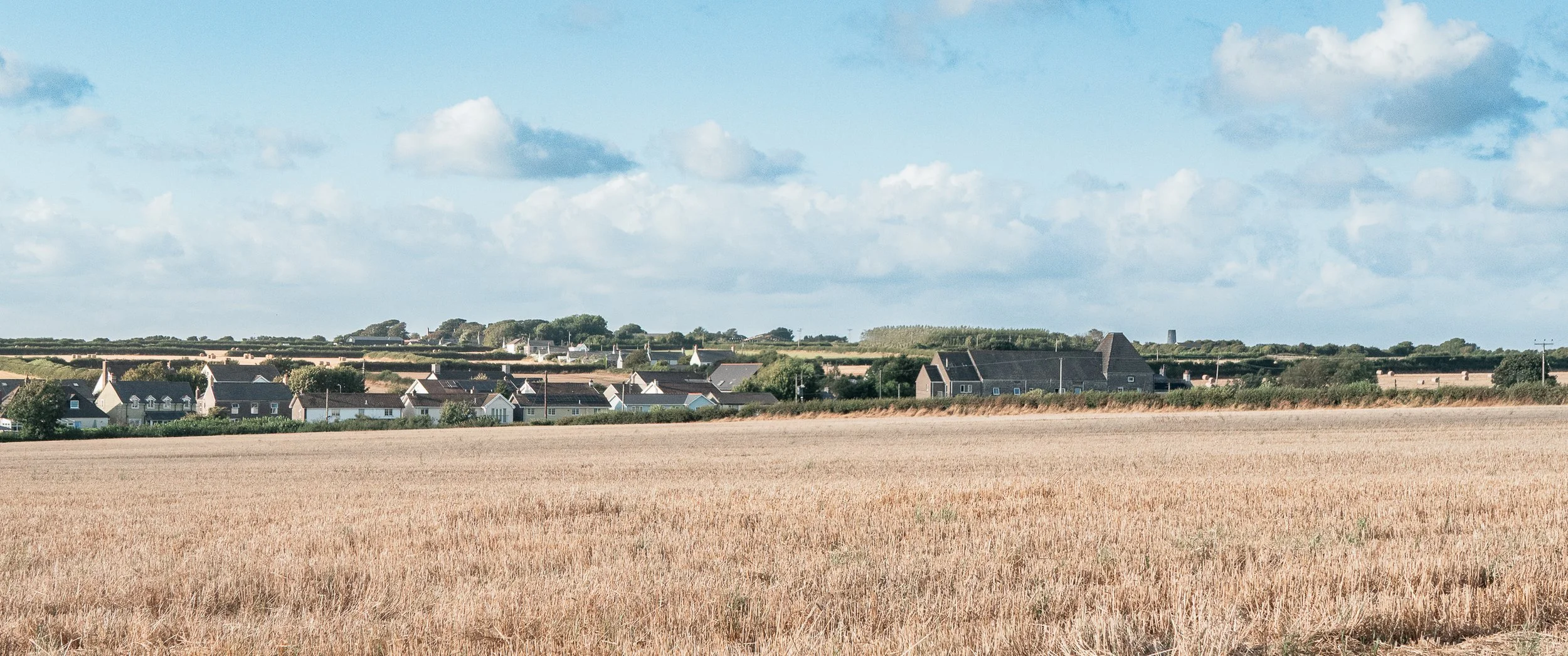
The view towards Broughton from the bus stop, after a very welcome stop at the Plough and Harrow — Toby refreshed, me considerably more refreshed.
Have a question about the walk, the photographs or print availability? Get in touch.